
The Rumored Sheep Farm, that now makes since!
- Edwin Preble
- 2 hours ago
- 4 min read

Around town lately there’s been a story over the years floating around like a grocery bag in a March wind: about there one time being one lady who owned “most of the land” and she had a massive sheep farm. Yet no one knows where but it’s somewhere out past the stone walls, beyond the “you can’t get there from here” roads, in the mystical zone where GPS gives up and just says, “good luck.”
Now, do I know if the sheep farm is real? No.
Do I know if it’s possible? Also no.
But do I know New Hampshire loves a good rumor the way blackflies love ankles? Absolutely.
And honestly, the funniest part isn’t whether the farm exists.
It’s the fact that the story still works even if it doesn’t—because if there is a sheep farm in this town, I’m starting to suspect…
we’re the sheep.
Because every year, like clockwork, we all line up and pay whatever number shows up on the tax bill. We grumble, we sigh, we say “that’s just how it is,” and then we go back to surviving mud season, heating oil season, and “why is my car making that noise” season. Meanwhile, the one thing that decides what we pay—the thing that should have a flashing neon sign over it—gets ignored like last year’s town report under a stack of junk mail:
The land. The lines. The map.
Not the house. Not the truck in the yard. Not your new porch steps.
The land. The lines. The part of the sandwich nobody checks until it tastes… suspicious.
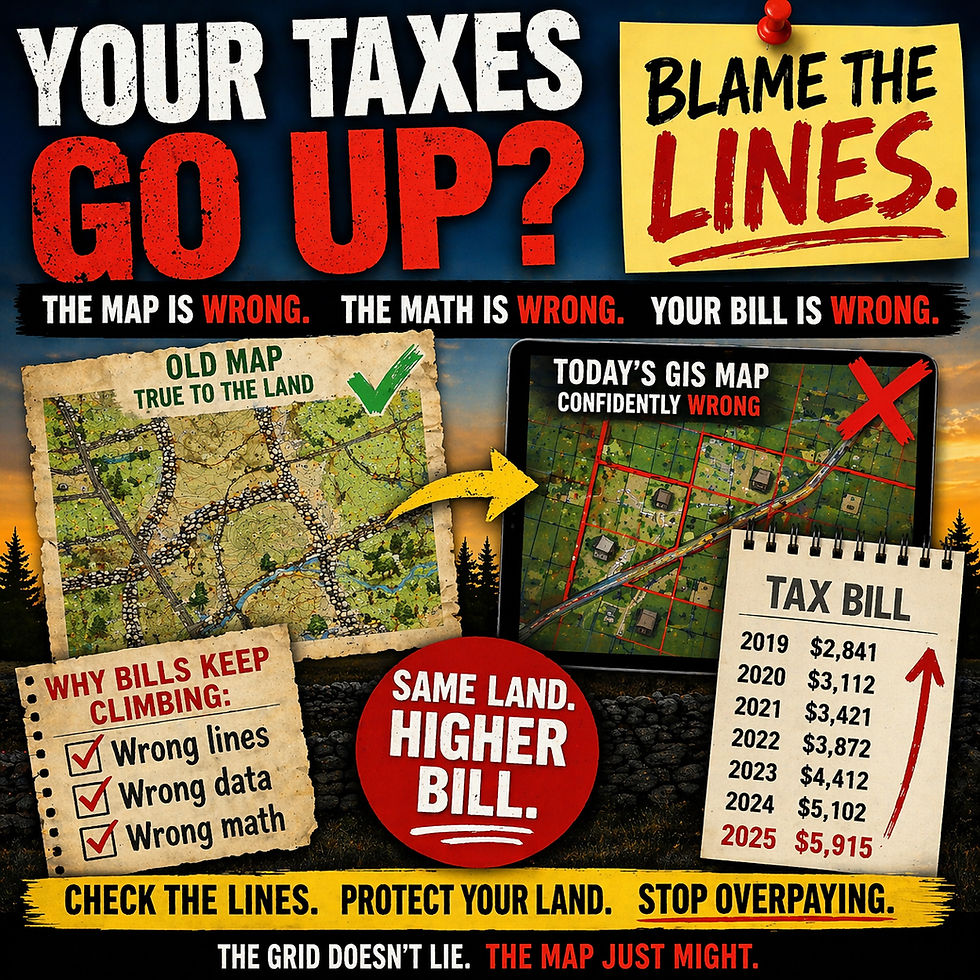
Here’s how it works in plain English: property taxes don’t start with your feelings. They start with land + lines. The town tax map tells the town how much land you supposedly own, where it supposedly is, and what it’s supposedly worth. Those lines decide your taxable footprint. So if boundaries get sloppy, shifted, copied, “interpreted,” or built off a bad reference, the math gets sloppy too—and then your tax bill starts feeling like it was calculated by a goat on espresso with a broken calculator.
And what do we blame when the bill goes up? The school. Every time. The school is the top of the blame pyramid. “The school made my taxes go up.” And yes, school budgets matter. But here’s the part nobody wants to say out loud because it ruins the simplicity of the argument: the school is often the headline, not the engine.
Because if the land system underneath is warped—if acreage, boundaries, and valuations are based on maps that don’t match the ground—then the tax burden doesn’t spread fairly. Some people end up paying more than they should. Some people pay less than they should. And the rest of us are standing there with a two-bedroom, a woodstove, and a tax bill that looks like we own a ski resort.
It’s like we’re all arguing about pizza toppings while somebody quietly redraws the pizza cutter lines and goes, “Huh. Weird. Yours is bigger now. That’ll be extra.”
And that’s why the sheep farm rumor matters. Because this whole mess only works if people keep believing the land is boring. It’s not boring. Land is the scoreboard. Land is the tax base. Land is the thing that turns into power when paperwork gets twisted. When town lines and big-lot boundaries get misrepresented, it doesn’t just create neighbor drama—it affects assessments, permits, access rights, development decisions, and the long money flow that decides who wins and who pays.
And here’s the real kicker:
high taxes keep people in debt, and debt keeps people too busy to ask questions. When you’re hustling just to keep the lights on, keep the truck inspected, keep food in the fridge, and keep the roof from leaking, you don’t have time to go dig into maps and deeds and why a “right-of-way” keeps showing up like it’s full ownership. You’re running the rat race, and the rat race is loud.
But if the people making decisions were truly thinking like regular residents—people who buy heating oil, people who know what it’s like when the grocery bill jumps $40 for no reason—then the instinct would be the same as everyone else’s: keep taxes low, keep records clean, keep things fair. You don’t “accidentally” protect a broken system forever if it’s hurting your neighbors. You fix it. You simplify it. You make the map match the land.
So when taxes keep climbing and the land mess underneath never gets corrected, people start wondering why the story always ends the same way: bills go up, confusion stays, and the public gets told to stop asking questions and “trust the process.”
Which brings me back to the sheep farm.
Because whether that farm exists or not, this part is real: the land is the foundation of the whole tax machine, and the “grid”—the original lines, the true layout, the real boundary logic on the ground—is the part that can expose what changed, when it changed, and how it changed. When you understand the grid, you can spot when access rights are being treated like ownership, when old references get reused to justify new claims, and when town-line confusion turns into a cash machine.
So next time you hear that rumor—“one lady owns most of the land and has a giant sheep farm”—don’t just laugh and move on.
Smile… and ask the real question:
If there was ever sheep farm in town… who’s actually getting sheared?


Comments